


Checkpoint Inhibitor Response Monitoring: Timely Guidance Using ctDNA
The following section discusses using ctDNA for monitoring the response to checkpoint inhibitors in patients with cancer. It provides the rationale for using liquid-biopsies, reviews the data to support it, has case examples illustrating its use, and offers practical guidance on the test.
We thank George Ansstas, MD, Associate Professor in the Oncology Division of Washington University School of Medicine in Saint Louis, for his contributions to this primer.
STATUS: Advances in immunotherapy have ushered in a new era of oncology.
PROBLEM: At most, 20% of patients achieve a sustained response to checkpoint inhibitors. [Robert 2020] Although new therapeutic approaches are being developed to address this challenge, key questions remain about treatment decision-making, including:
- How can we know if treatment is working?
- How quickly can we assess response?
- How and when should treatment be sequenced or re-initiated?
SOLUTION: Enhanced monitoring to assess response and inform decision making as early as possible. Existing tissue-based biomarkers (such as PD-L1, tumor mutational burden, etc.) are not useful for predicting the response to immunotherapy. But there is an effective approach.
Rationale for Use of Circulating Tumor Cell DNA (ctDNA)
- Patients with cancer have more circulating DNA (segments of DNA that are released from living or dead cells) than individuals without cancer.
- This difference is related to tumorigenesis (high rate of cell death in large tumors as well as tumor aggressiveness)
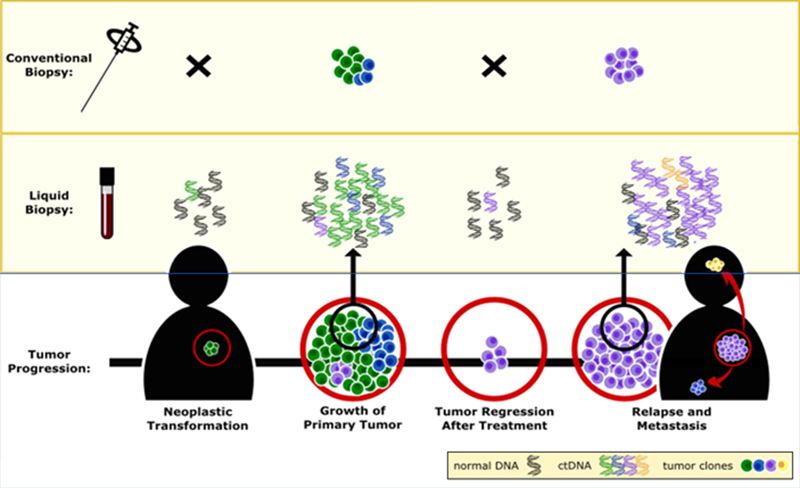
- Release of ctDNA fragments is increased at several stages of tumorigenesis, with the highest concentrations in metastatic disease (See Figure 1)
- Therefore, measurement of ctDNA has a potential role in diagnosis, prognosis, and treatment monitoring
Figure 1. Sensitive tumor detection with ctDNA. The diagram shows tumor progression and the ability of different biopsy techniques to detect tumor burden at different time points. This illustration shows how liquid biopsy can detect low levels of tumor burden that are missed by conventional biopsy techniques (for example, at neoplastic transformation and at tumor regression after treatment). Adapted from Anmery, CC BY-SA 4.0 <https://creativecommons.org/licenses/by-sa/4.0>, via Wikimedia Commons.
Why ctDNA Is Beneficial
- ctDNA is an established liquid biopsy technique in oncology
- ctDNA tests can be used to monitor the response to checkpoint inhibitors in patients with cancer
- The tests are personalized for each patient’s own tumor mutational signature and can be used to monitor treatment response or detect disease recurrence earlier than clinical assessment and radiologic scans [Abbosh 2017]
- The INSPIRE study demonstrated the efficacy of this test for checkpoint inhibitor response monitoring in patients treated with pembrolizumab [Bratman 2020]
- Similar results have been seen in other studies, including a study specific to melanoma and anti-PD1 therapy [Seremet 2019]
- However, ctDNA has not been found effective in detecting or monitoring intracranial disease in the setting of melanoma [Lee 2020]
- Real-world data support the use of ctDNA testing in patients with unresectable Stage III/IV during treatment with anti-PD-1-based therapy [Ma 2026]
- Patients who had a decrease in ctDNA as early as three to four weeksafter treatment had better treatment outcomes:
- A 30-times higher chance of having disease control (cancer shrinking or stopping growing after treatment).
- A 23-times higher chance of having an objective response (experiencing a complete or partial response)
- An 82% reduction in the risk of progression (cancer growing, spreading, or returning over time)
- A 72% reduction in the risk of death
- One-year overall survival rate (the percentage of people who are still alive) of more than 90%o Patients whose ctDNA levels increased during the first few weeks of therapy had poor prognoses, with median progression free survival (the length of time from the start of a treatment until the disease gets worse or the patient dies) of only 2.3 months)
- A 30-times higher chance of having disease control (cancer shrinking or stopping growing after treatment).
- Patients who had a decrease in ctDNA as early as three to four weeksafter treatment had better treatment outcomes:
- Real-world data for patients with resected Stage I–IIIB melanoma (including high-risk patients) who received a personalized ctDNA test [Ansstas 2026]
- Patients with resected Stage I to IIIB melanoma are at risk for recurrence
- ctDNA positive test results were associated with poor recurrence-free survival (the length of time a patient remains entirely free of cancer)
- Among patients with positive ctDNA tests, nearly three-quarters experienced a change in care including intensified imaging, treatment initiation, treatment switching, or treatment escalation
- Systemic therapy was started in some patients based on detection of ctDNA alone, before evidence of disease was seen with imaging. In these cases, ctDNA clearance was observed following therapy with durable disease-free status observed in some patients.
- Patients with resected Stage I to IIIB melanoma are at risk for recurrence
Performance Characteristics of the ctDNA Test
In the INSPIRE trial: [Bratman 2020]
- The test identified metastatic disease in 98% of patients
- Positive predictive value (increasing ctDNA levels in conjunction with imaging):100% for nonresponse
Not all tumors shed ctDNA equally. ctDNA levels are highest in tumors such as triple-negative breast cancer and small-cell lung cancer, whereas they are lower in thyroid cancer, melanoma, and renal cell carcinoma. [Zhang 2021; Bratman 2020] However, in the INSPIRE study, the test worked well across tumor types, suggesting that the variation in shedding does not affect the test performance for monitoring checkpoint inhibitor efficacy.
Case Scenarios Showing Applications of ctDNA Monitoring
Because the ctDNA test enables more sensitive detection of response as compared with other biomarkers or imaging scans, it enables earlier informed treatment decisions. Potential clinical scenarios to illustrate its utility include the following:
Selection of an Aggressive Combination vs Single-Agent Approach
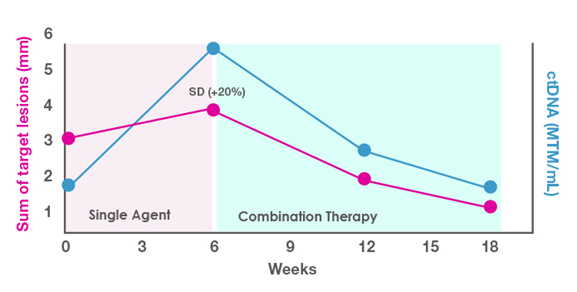
You are evaluating a 65-year-old man with lung cancer and multiple comorbidities for single-agent vs combination therapy in the first-line setting. You decide to use the single-agent approach and monitor the response with ctDNA. As shown in Figure 2, at 6 weeks you see a rise in ctDNA levels and a slight increase in tumor measurements (stable disease). Based on this lackluster response, you decide to add a second agent to the therapy. In this situation, the combination approach was effective, as shown in the drop in both ctDNA levels and target lesion measurements after the second agent was added.
Figure 2. ctDNA-guided decision making for a patient with stable disease (SD).
Determining the Treatment Course When Imaging Results Are Difficult to Interpret
You are following a 42-year-old woman with liver metastases from triple-negative breast
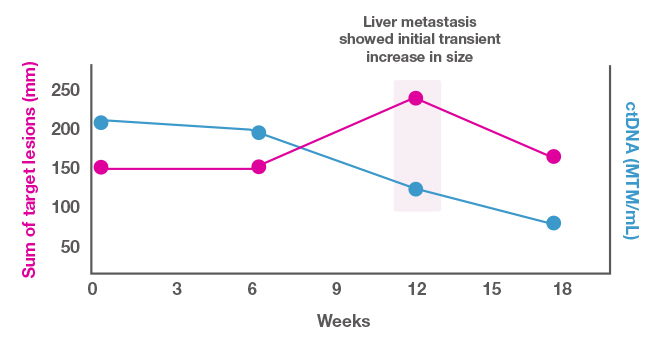
cancer who is receiving immunotherapy. As shown in Figure 3, the target lesion appears to be growing, but the ctDNA level is dropping. You suspect that the lesion expansion is pseudoprogression, characterized by an initial increase in the size of a tumor or new lesion formation during the early stages of checkpoint inhibitor therapy. [Jia 2019] Given the drop in the ctDNA levels, you feel confident in keeping the patient on the current therapy. This decision appears correct, since both the target lesion size and ctDNA levels drop thereafter.
Figure 3. Role of ctDNA in treatment decision making in a patient with pseudoprogression.
Determining Whether Therapy Can Be Stopped
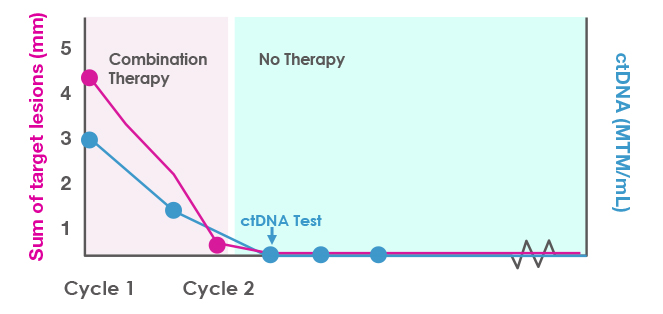
After obtaining a baseline ctDNA level, you treat a 35-year-old woman who has aggressive Stage IV melanoma with combination checkpoint inhibitor therapy. She completes 2 cycles but gets very sick with immune-related adverse effects, and you discontinue therapy. However, her scans look much improved after the discontinuation, as shown in Figure 4, At the next ctDNA check, her level is 0 MTM/mL. The clearance of the ctDNA is consistent with a molecular complete response. You decide not to reinitiate therapy and just monitor her at this point. The next few ctDNA tests continue to show clearance, suggesting a durable response.
Figure 4. ctDNA monitoring to clarify the duration and depth of response in a patient with a strong early response to combination therapy.
Patient Resources
Share this article and accompanying patient guide with your patients for information on ctDNA testing, including answers to frequently asked questions. The guide is available within the article.
References
Abbosh C, Birkbak NJ, Wilson GA, et al; on behalf of the TRACERx and PEACE consortia. Phylogenetic ctDNA analysis depicts early-stage lung cancer evolution. Nature. 2017;545:446-451.
Ansstas G, Khaddour K, Sudhaman S, et al. Longitudinal ctDNA Monitoring for Postsurgical Disease Surveillance in Patients with Stage I to IIIB Melanoma. Clin Cancer Res. 2026;32(8):1513-1521.
Bratman SV, Yang SYC, Iafolla MAJ, et al. Personalized circulating tumor DNA analysis as a predictive biomarker in solid tumor patients treated with pembrolizumab. Nat Cancer. 2020;1:873–881.
Jia W, Gao Q, Han A, Zhu H, Yu J. The potential mechanism, recognition and clinical significance of tumor pseudoprogression after immunotherapy. Cancer Biol Med. 2019;16:655-670.
Lee JH, Menzies AM, Carlino MS, et al. Longitudinal monitoring of ctDNA in patients with melanoma and brain metastases treated with immune checkpoint inhibitors. Clin Cancer Res. 2020;26:4064-4071.
Ma VT, Zhou AY, Forati A, et al. Multi-Institutional Study Evaluating the Role of Early Circulating Tumor DNA Dynamics During Treatment With Immune Checkpoint Inhibitors in Patients With Advanced-Stage Melanoma. JCO Precis Oncol.2026;10:e2500254.
Robert C. A decade of immune-checkpoint inhibitors in cancer therapy. Nat Commun. 2020;11, 3801. https://doi.org/10.1038/s41467-020-17670-y
Seremet T, Jansen Y, Planken S, et al. Undetectable circulating tumor DNA (ctDNA) levels correlate with favorable outcome in metastatic melanoma patients treated with anti-PD1 therapy. J Transl Med. 2019;17:303. doi: 10.1186/s12967-019-2051
Zhang Y, Yao Y, Xu Y, et al. Pan-cancer circulating tumor DNA detection in over 10,000 Chinese patients. Nat Commun. 2021;12(1):11. doi: 10.1038/s41467-020-20162-8